The Vibe Coding Bottleneck: Why Your Voice is the Real Compiler in 2026
February 27, 2026
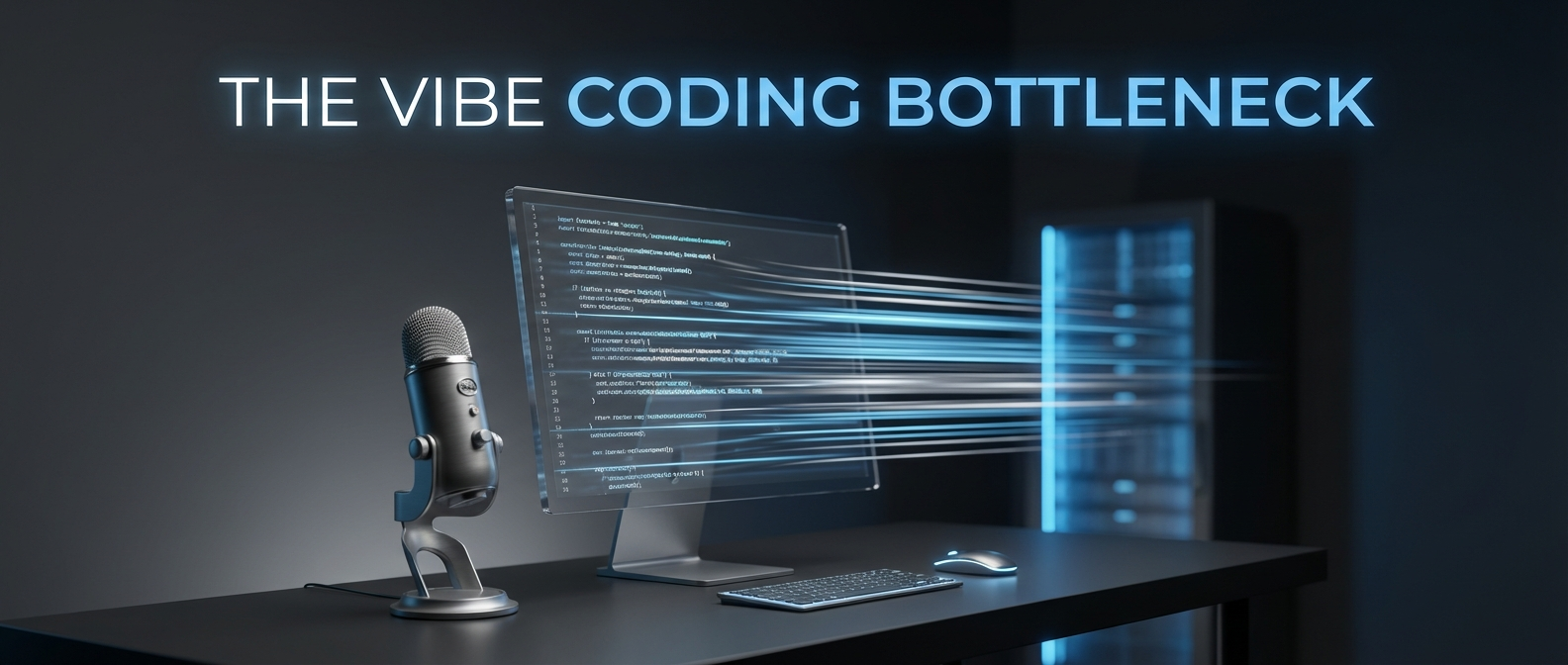
The industry is currently swept up in a "productivity panic." With the release of Xcode 26.3 and the brutal race between Anthropic’s Claude Code and OpenAI’s latest agentic models, we were promised an era of "vibe coding." The dream was simple: chat with an agent, and watch a finished application emerge from the ether.
But as we settle into late February 2026, a different reality is setting in for high-performance engineers. The bottleneck isn't the model's intelligence; it's the bandwidth of the human intent.
The Intentionality Tax
When you use a chat interface to "vibe code," you are effectively writing a high-level specification. But high-level specifications are notoriously leaky. An agent can generate 1,000 lines of boilerplate in seconds, but it cannot know the specific architectural nuance, the performance trade-off, or the precise user experience you have in your head.
This creates the Edit Tax. You spend more time reviewing, correcting, and "massaging" the agent's output than you would have spent writing the core logic yourself if you had a higher-bandwidth uplink.
This is where the traditional keyboard fails. Typing is a high-latency, serial process. It was designed for the era of the typewriter, not the era of the agentic compiler. If you want to direct an agent at the speed of thought, you need a different input vector.
Your Voice is the New CLI
In 2026, the most productive developers aren't just "chatting" with AI. They are using Agentic Dictation.
Think about the difference. A standard dictation tool (like the native Win+H on Windows) is built for emails. It’s slow, it’s prone to "hallucinating" punctuation, and it falls apart the moment you try to dictate inside a remote environment or a VDI like Citrix.
DictaFlow was built specifically for this "vibe coding" era. It treats your voice not as a transcription task, but as a high-bandwidth command stream.
- VDI Bypass: While other tools lag out the moment you open an RDP session or a remote VS Code instance, DictaFlow’s driver-level integration ensures your intent lands in the editor at the speed of the local kernel.
- The "Actually Override": This is the killer feature for 2026. In the middle of a sentence, if you realize the agent is going in the wrong direction, you can hold-to-talk and literally override the buffer. You don't wait for the text to appear; you direct the flow in real-time.
- Hold-to-Talk Ergonomics: "Always-on" microphones are a nightmare in a busy office or a home with kids. DictaFlow’s physical hold-to-talk mechanic mirrors the precision of a professional radio—you only transmit when your intent is ready.
Closing the Professional Input Gap
The "productivity panic" of 2026 is real for those stuck using 1970s input methods to drive 2026 intelligence. When you bridge the gap between your brain and the agent with a low-latency, high-accuracy voice uplink, the panic disappears.
You aren't just "vibe coding" anymore. You are conducting.
Stop typing your specs. Start dictating your vision.
Try DictaFlow today at https://dictaflow.io/ and experience the only dictation engine built for the age of agentic coding.
Related DictaFlow Guides
Explore the pages built for the exact workflows these posts keep touching: Windows dictation, Citrix/VDI, medical documentation, legal drafting, and side-by-side comparisons.
Ready to stop typing?
DictaFlow is the only AI dictation tool built for speed, privacy, and technical workflows.
Download DictaFlow Free