The Ambient Scribe Honeymoon Is Ending: The Strategic Dictation Era Starts in 2026
February 27, 2026
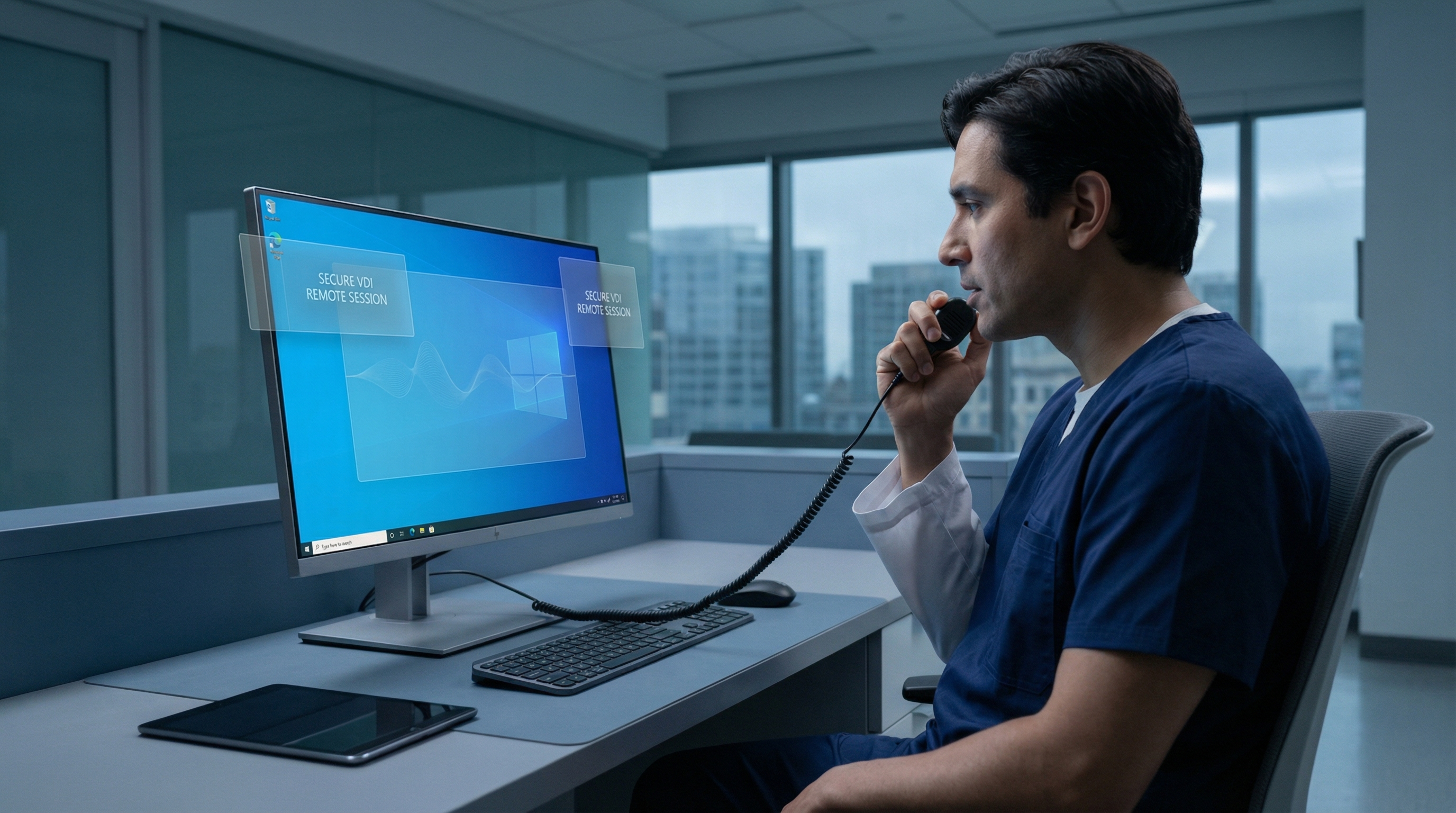
For the last year, healthcare AI talk has sounded almost identical at every event. Buy an ambient scribe, connect it to the EHR, and watch burnout disappear. It was a clean story. Clinicians hated documentation. Ambient tools promised to listen, draft notes, and give time back.
Now the market is maturing, and the story is getting more honest.
At ViVE 2026, one of the loudest themes was that "scribe mania" is cooling off and health systems are shifting toward strategic adoption. The winners are not just asking, "can this generate a note?" They are asking harder questions: Does it hold up in high-volume real workflows? Does it behave inside locked-down VDI environments? Can clinicians correct output quickly without breaking their pace? And can compliance teams actually govern the rollout?
Those are the right questions.
Why ambient alone is no longer enough
Ambient documentation is real progress, but it is not a full workflow strategy. Most hospitals and large practices operate in mixed infrastructure. Some clinicians work on local Windows machines. Others are inside Citrix, RDP, or other virtual desktop environments all day. That reality changes everything.
A beautiful AI transcript does not help much if the final text input layer is slow, laggy, or blocked by VDI behavior. In many organizations, the bottleneck is no longer speech recognition quality. The bottleneck is input reliability at the last mile, exactly where the clinician needs to move fast.
This is where health systems are getting more practical in 2026. They are moving from "feature checklist" buying to "workflow friction" buying.
The new buying criteria in 2026
Based on current healthcare AI trend coverage and enterprise conversations, three criteria are showing up repeatedly.
First, governance is no longer optional. "Shadow AI" exploded in 2025, and leadership teams are now trying to regain control without killing productivity. That means approved tools, auditable behavior, and clear guardrails.
Second, trust now includes correction speed. Accuracy matters, but so does recoverability. Clinicians need to fix one phrase, one medication name, or one diagnosis line in the middle of dictation without restarting their thought process.
Third, infrastructure fit is a board-level issue. If the tool fails in VDI, it fails for a meaningful chunk of enterprise users. Simple as that.
What this means for frontline clinicians
Most clinicians are not asking for futuristic AI narratives. They want less charting drag after a long clinic day. They want notes that are usable on the first pass. They want fewer context switches. They want to keep eye contact with patients and still finish documentation before dinner.
In practice, that means speed plus control.
Speed without control creates cleanup work. Control without speed creates frustration. The best systems balance both: rapid capture, clean formatting, and fast in-line correction when the model gets a detail wrong.
The strategic gap nobody can ignore
Healthcare AI buyers often evaluate note quality, then treat text entry as a commodity layer. In standard desktop setups, that can work. In VDI-heavy organizations, it often breaks.
If the dictation layer cannot reliably inject text into Citrix or remote sessions, adoption stalls, even when users like the language quality. Clinicians quietly revert to old workflows. IT teams misdiagnose the issue as "user resistance." Leadership wonders why ROI is weak.
The root cause is usually simpler: the tool solved transcription, but not input.
Where DictaFlow fits in this shift
This is exactly the shift DictaFlow was built for.
DictaFlow is a Windows-native dictation workflow designed for real enterprise environments, including Citrix and VDI setups where many consumer-grade tools struggle. The goal is not to replace clinician judgment. The goal is to remove input friction so clinicians can stay in flow.
Three product behaviors matter most in that context:
- Citrix and VDI bypass for reliable text insertion in remote desktop workflows.
- Hold-to-Talk dictation for deliberate control in fast clinical settings.
- Actually Override, which lets users correct active text mid-sentence instead of patching notes later.
That combination maps directly to what the market is now demanding: reliability, control, and practical speed.
From AI excitement to operational discipline
The most important change in 2026 is cultural. Health systems are moving from AI excitement to operational discipline.
That sounds less glamorous, but it is better for clinicians.
Operational discipline means selecting tools that survive real infrastructure constraints. It means measuring reductions in after-hours charting, not just demo quality. It means training users on correction workflows, not only prompt tips. And it means treating documentation as a system problem, not a single model problem.
When teams do that, adoption improves because the product matches real work.
The practical playbook for IT and clinical leaders
If you are evaluating documentation AI this quarter, keep the process simple and honest.
Start with a mixed-environment pilot group, not just power users on ideal hardware. Include clinicians in Citrix or other VDI workflows from day one.
Track three outcomes for four to six weeks:
- Time-to-final-note in real patient volume.
- Correction burden per note, especially for medications and assessment sections.
- After-hours charting minutes per clinician.
Then run a blunt technical review. Did text insertion hold up in every target environment? Were failures predictable and recoverable? Could users fix mistakes without cognitive reset?
If those answers are yes, you have something deployable. If not, keep looking.
The next 12 months
The ambient wave did what early waves are supposed to do. It proved demand. It got budgets unlocked. It pushed documentation automation into mainstream healthcare operations.
Now comes the harder phase, where durable products separate from attractive demos.
In this phase, the winners will be systems that fit real clinical infrastructure, reduce daily friction, and give clinicians confidence that they can control the output in the moment.
That is the strategic dictation era. It is already here.
If your organization is moving from AI experimentation to enterprise rollout, this is the right moment to prioritize workflow reliability over hype.
Learn more at https://dictaflow.io/ and see how a Windows-native, VDI-ready dictation workflow performs in real clinical environments.
Related DictaFlow Guides
Explore the pages built for the exact workflows these posts keep touching: Windows dictation, Citrix/VDI, medical documentation, legal drafting, and side-by-side comparisons.
Ready to stop typing?
DictaFlow is the only AI dictation tool built for speed, privacy, and technical workflows.
Download DictaFlow Free