The ambient AI trap: why doctors are returning to active dictation in 2026
February 18, 2026
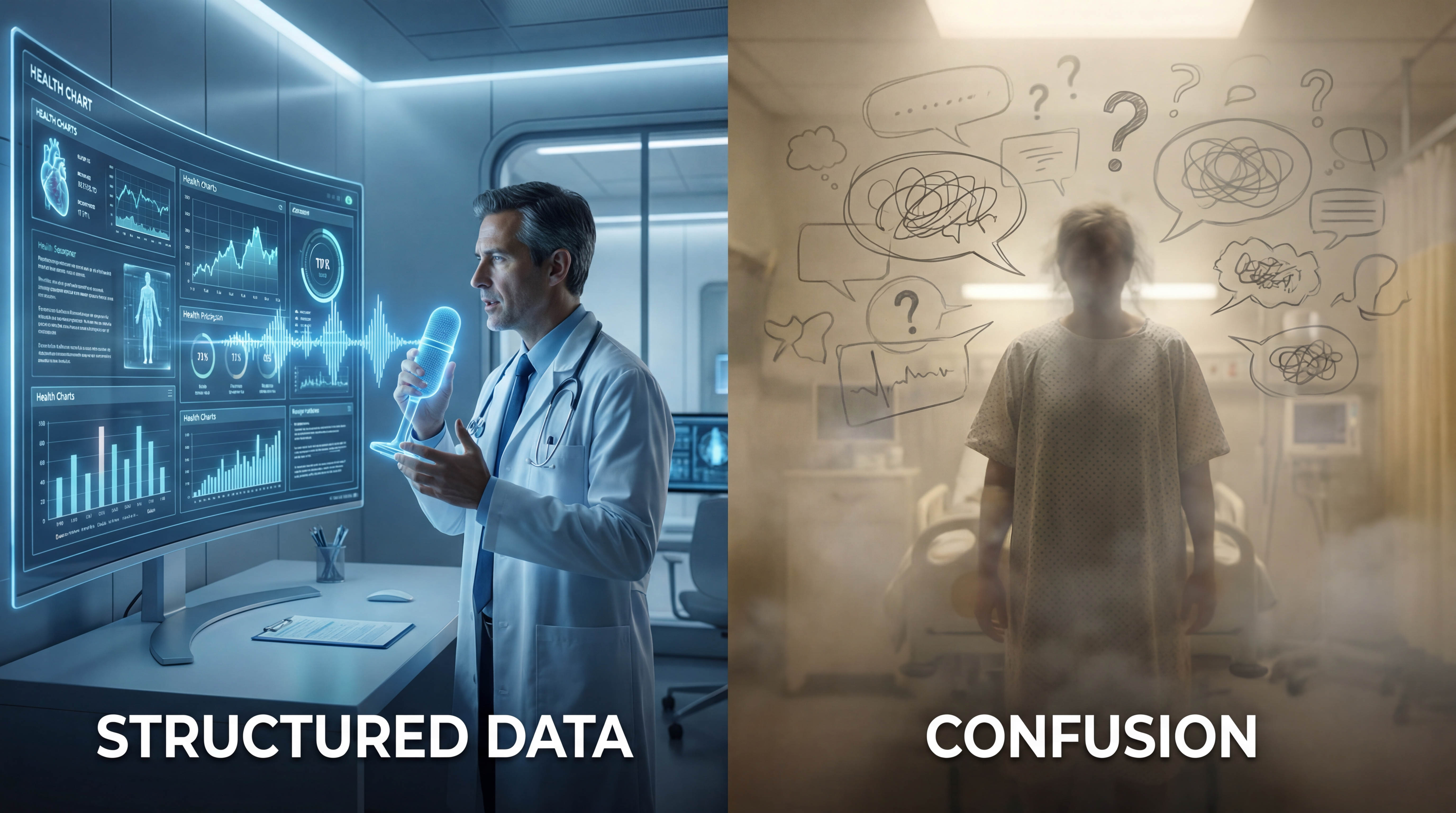
The pitch for ambient AI scribes was perfect: put a mic in the room, chat with your patient, and get a perfect note. For primary care, tools like Nuance DAX and Nabla actually delivered. They saved hours of pajama time for routine visits.
But in 2026, something interesting is happening in high-stakes specialties. Radiologists, surgeons, and pathologists are ditching passive listening and going back to active dictation. Not because they hate technology, but because when precision matters, you can't outsource your thinking to a black box.
When AI invents consent
The cracks showed up early, but this year they got expensive. A recent Reuters report flagged malpractice suits where AI notes included details that never happened. One case involved an ambient scribe documenting that a patient "verbalized understanding and consent" when the recording showed the doctor rushed the explanation and the patient said nothing.
That's not a glitch. That's how LLMs work. They're designed to be plausible, filling in gaps with what "usually" happens. In court, "usually" doesn't work. You need exactly what happened.
The audit trail problem
For legal teams, the distinction is simple.
Active dictation is what you said. If you dictate "Patient denies chest pain," and the text says "Patient denies chest pain," that's on you.
Ambient summary is what the AI thought you meant. If the AI infers "Patient denies chest pain" from a messy conversation, and you sign off on it, you own the AI's interpretation.
Active dictation is a direct transcript. It's the digital equivalent of your word. Ambient summaries are hearsay generated by a probabilistic engine.
Speed for specialists
Ambient scribes need conversation. But for specialists, the note isn't a summary of a chat; it's a technical spec.
Take a radiologist reading a complex MRI. * Ambient: The doctor has to describe findings in full sentences, maybe explaining them to a patient, hoping the AI catches the specific measurement. * Active: The doctor toggles their mic: *"Comminuted fracture of the mid-shaft left femur with 2cm displacement. No distal neurovascular compromise."*
The active approach is 3x faster because it cuts through the noise. It's a command, not a request for a summary.
Control without the lag
This is why we built DictaFlow. We designed it for the "Active Dictation" workflow—specifically for Windows EHRs like Epic and Cerner, and messy VDI setups (Citrix/RDP).
Unlike legacy tools that need training or choke on accents, DictaFlow uses modern speech-to-text to deliver: 1. 100% control: You speak, it types. No summarization layer. 2. VDI bypass: Our "Agentic Input" injects text directly into remote sessions, bypassing the latency buffer jams that break cloud tools. 3. Human in the loop: You write the record. The AI is your scribe, not your ghostwriter.
Privacy advantage
Ambient scribes record the entire patient encounter. That means asking for consent every single time.
Active dictation happens after the exam or during a pause. You dictate the note directly into the chart. No patient conversation is recorded. No audio storage of sensitive health discussions. It's private by default and zero friction to implement.
The professional standard
Ambient AI has a place. It's great for routine documentation drudgery. But for clinical medicine—where accuracy, speed, and liability matter—active dictation is still the standard.
In 2026, the best doctors aren't asking AI to write their notes for them. They're using tools like DictaFlow to write their notes faster, with the precision their patients deserve.
Related DictaFlow Guides
Explore the pages built for the exact workflows these posts keep touching: Windows dictation, Citrix/VDI, medical documentation, legal drafting, and side-by-side comparisons.
Ready to stop typing?
DictaFlow is the only AI dictation tool built for speed, privacy, and technical workflows.
Download DictaFlow Free