The Consent and Audit Gap in Ambient Documentation, and Why Hold-to-Talk Is Gaining Ground
March 02, 2026
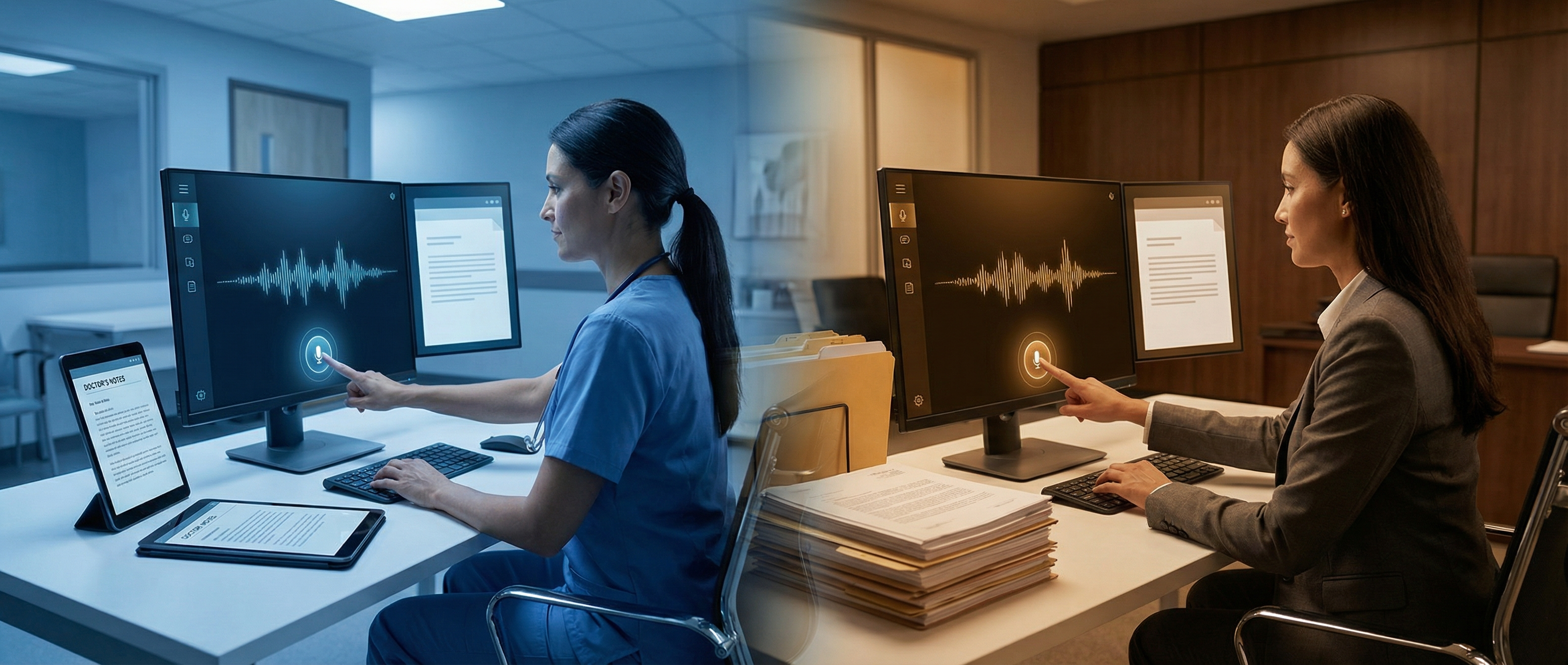
Ambient documentation is having a breakout moment in healthcare and legal work. You can feel it in every product demo: "just talk naturally, we'll handle the notes." After years of template fatigue, that pitch is landing. People are tired, charts are late, and no one wants to spend another evening cleaning up documentation.
But the bigger story in 2026 is not speed alone. It is control.
Teams are realizing that "always listening" tools create a new kind of operational risk. If your documentation layer is continuously capturing conversation, you have to answer hard questions every day: when did recording start, who consented, what got stored, what was transformed by the model, and who approved the final text? In regulated environments, those questions do not stay theoretical for long.
That is where a quieter shift is happening. More organizations are moving away from passive capture and toward intentional capture. In plain terms, people want to decide exactly when the system listens.
Why ambient-first is being challenged
Ambient workflows solved a real pain point. They reduced typing, improved throughput, and gave clinicians and attorneys more face time with people in front of them. That progress matters.
Still, ambient systems introduce four recurring pressure points:
1. Consent ambiguity in mixed spaces. In clinics, exam rooms are not acoustically isolated thought bubbles. Family members walk in, side conversations happen, and staff transitions are constant. In legal environments, privileged and non-privileged discussion can alternate quickly. Ambient tools may capture more than intended before someone notices.
2. Audit complexity. When capture is continuous, your audit story gets complicated. You need dependable event trails: start and stop boundaries, user intent, revisions, and approval points. Without clean boundaries, retrospective reviews turn into guesswork.
3. Error correction latency. When a model drafts a long note from long audio, fixing one wrong clause can trigger a chain of edits. Users often end up re-reading entire sections to verify meaning. The promise of speed can disappear in cleanup.
4. Trust drift. Even if output quality is high, users lose confidence when they cannot see or control capture windows. Small uncertainty accumulates. Once trust slips, adoption stalls.
None of this means ambient tools are "bad." It means passive capture is not the right default for every workflow.
The return of deliberate dictation
What is working in high-accountability teams right now is a simpler interaction model:
- press to speak
- release to stop
- see text instantly
- correct in place before moving on
That pattern feels familiar because it mirrors how people already manage sensitive information. You choose the moment, say the thing, verify it, then continue.
This is why hold-to-talk (PTT) has moved from "old school" to practical advantage. It creates explicit boundaries without adding ceremony. The user stays in charge of capture scope, and audit logs become easier to defend because intent is visible in interaction events.
In legal drafting, that means tighter control around privilege-sensitive passages. In clinical settings, it means fewer accidental captures during room transitions and side conversations. In both cases, it reduces the gap between what was said and what should become record.
Speed still matters, but speed without control does not scale
There is a misconception that deliberate capture is slower. In real usage, the opposite can be true.
Passive systems can look fast in demos because they postpone friction. The friction shows up later in verification, redaction, and reconstruction. Deliberate systems surface friction earlier, when fixes are cheaper and context is fresh.
The strongest deployments in 2026 are optimizing for total cycle time, not first-draft time. That includes:
- capture time
- correction time
- approval time
- compliance review time
If your tool is fast at step one but expensive at steps two through four, it is not actually fast.
Where DictaFlow fits
DictaFlow is built for this control-first reality on Windows, especially in Citrix and VDI-heavy environments where traditional voice stacks lag or fail.
The design priorities are straightforward:
- Hold-to-Talk by default for clear capture intent
- Fast, local-feeling interaction in Windows workflows
- Reliable operation through Citrix and remote desktop constraints
- "Actually Override" correction so users can replace mistakes mid-sentence without wrestling long drafts
That last point matters more than it sounds. People do not just need transcription. They need steering. If correction is clumsy, output quality drops and trust disappears. Override-level control keeps users moving while preserving accuracy.
A practical framework for teams evaluating documentation AI now
If you are comparing vendors this quarter, skip broad "AI maturity" scorecards and run a narrow workflow test instead.
Ask these seven questions:
- Can users control exactly when capture starts and stops?
- Is consent state obvious in the interface at all times?
- Can a user correct a single phrase without reworking the whole note?
- Are audit events readable by compliance teams without reverse engineering?
- Does performance hold inside Citrix or VDI sessions?
- Can teams enforce role-based defaults for sensitive contexts?
- After a week of use, do users trust the system more or less than day one?
The seventh question is the one most teams miss. Adoption fails when trust decays, even if baseline accuracy looks good on paper.
The next year: hybrid by design
The future is not ambient versus dictation. It is adaptive workflows that switch modes based on context and risk.
Routine sections may use broader capture. Sensitive sections will use explicit capture boundaries. Teams will demand both in one system, with policy controls that do not slow down frontline work.
That is where the market is heading: not toward "record everything," but toward "capture with intent, prove it, and move fast anyway."
If documentation is becoming an operational system of record, control is no longer optional. It is the feature.
Related DictaFlow Guides
Explore the pages built for the exact workflows these posts keep touching: Windows dictation, Citrix/VDI, medical documentation, legal drafting, and side-by-side comparisons.
Ready to stop typing?
DictaFlow is the only AI dictation tool built for speed, privacy, and technical workflows.
Download DictaFlow Free