The 2026 Compliance Shift: Why Intentional Dictation Is Overtaking Always-Listening AI in Healthcare and Legal Work
March 04, 2026
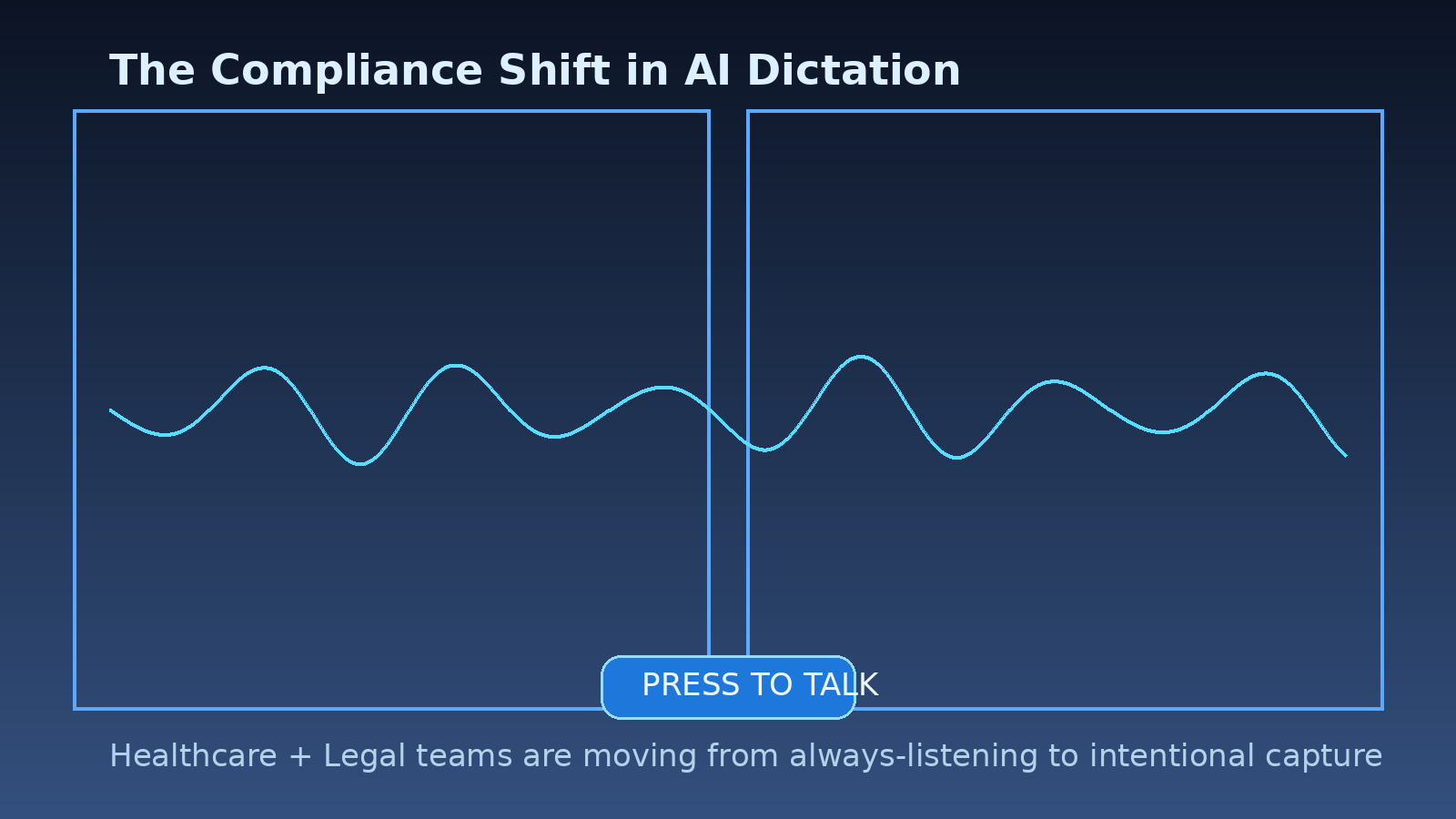
Ambient AI documentation has grown fast because it solves a real pain point. Clinicians and attorneys are exhausted by keyboard-heavy workflows, and "automatic" note capture looks like relief. That momentum is real.
But the biggest change in early 2026 is not just adoption. It is scrutiny.
Recent healthcare law analysis has highlighted a pattern of consent-risk and documentation-risk in ambient deployments, including claims tied to all-party consent states and uncertainty around how consent language is represented in finalized notes. At the same time, market growth has been explosive, with ambient scribing spending accelerating and deployments scaling before many organizations have matured their compliance operations.
That combination creates a familiar problem in regulated industries: tooling velocity exceeds governance velocity.
Why this matters right now
When a system is always listening, every encounter creates downstream compliance obligations. Teams need clear answers on start and stop boundaries, consent state, revision history, data retention, and who approved the final note. If those controls are weak, speed gains can be erased by remediation work, legal review, or trust erosion.
Healthcare teams are seeing this in room transitions, family-in-the-room scenarios, and mixed conversation contexts where sensitive and non-sensitive content can blur in seconds. Legal teams face the same pattern during client discussions that switch between privileged strategy and operational detail.
The technical challenge is no longer transcription quality alone. The challenge is operational control.
The practical shift: from passive capture to intentional capture
Across medical and legal documentation workflows, the highest-confidence pattern in 2026 is intentional capture.
Instead of relying on a passive always-on model, users increasingly prefer explicit capture boundaries. They press to speak, release to stop, review output immediately, and correct in place before moving forward.
That interaction model lowers ambiguity and improves defensibility. It produces clearer intent signals for audit trails and reduces accidental over-capture in sensitive contexts.
Where DictaFlow is directly relevant
This is exactly where DictaFlow delivers practical value, especially for Windows professionals working inside Citrix and VDI environments.
DictaFlow is Windows-native and designed for high-speed, controlled dictation in enterprise workflows. Hold-to-Talk creates explicit capture boundaries. "Actually Override" enables mid-sentence correction so users can fix meaning in the moment instead of rewriting long drafts later. The Citrix/VDI bypass focus addresses one of the most painful real-world failure points in hospital and legal desktop environments.
That combination matters because it improves total workflow time, not just first-draft time. Teams spend less effort on cleanup, less effort on reconstruction, and less effort proving what happened after the fact.
A concrete use case
Consider a physician documenting an outpatient consult in a Citrix-hosted EHR. During the encounter, a family member joins briefly and asks unrelated questions. In an always-listening workflow, the boundary between clinically relevant dictation and incidental conversation may be unclear unless staff manually intervene perfectly.
With DictaFlow, the physician controls capture windows directly with Hold-to-Talk, dictates findings when ready, and corrects terms in real time with Actually Override before committing the section. The record stays focused, the interaction stays fast, and the audit story is cleaner.
The same control pattern maps to legal drafting during client intake calls where confidentiality context can shift quickly.
The next 12 months
The market is unlikely to choose one mode forever. The likely winner is hybrid documentation with policy-driven switching between broader capture and strict intentional capture depending on risk level.
But one trend is already clear. In regulated environments, organizations are prioritizing tools that provide speed with control, not speed without boundaries.
That is why intentional dictation is gaining ground now.
If your team is evaluating documentation AI this quarter, test for auditability, correction friction, and VDI reliability, not just demo-time wow factor.
DictaFlow is built for that exact reality.
https://dictaflow.io/
Related DictaFlow Guides
Explore the pages built for the exact workflows these posts keep touching: Windows dictation, Citrix/VDI, medical documentation, legal drafting, and side-by-side comparisons.
Ready to stop typing?
DictaFlow is the only AI dictation tool built for speed, privacy, and technical workflows.
Download DictaFlow Free