Half of American Workers Now Use AI: What That Means for Voice Dictation Tools
April 15, 2026
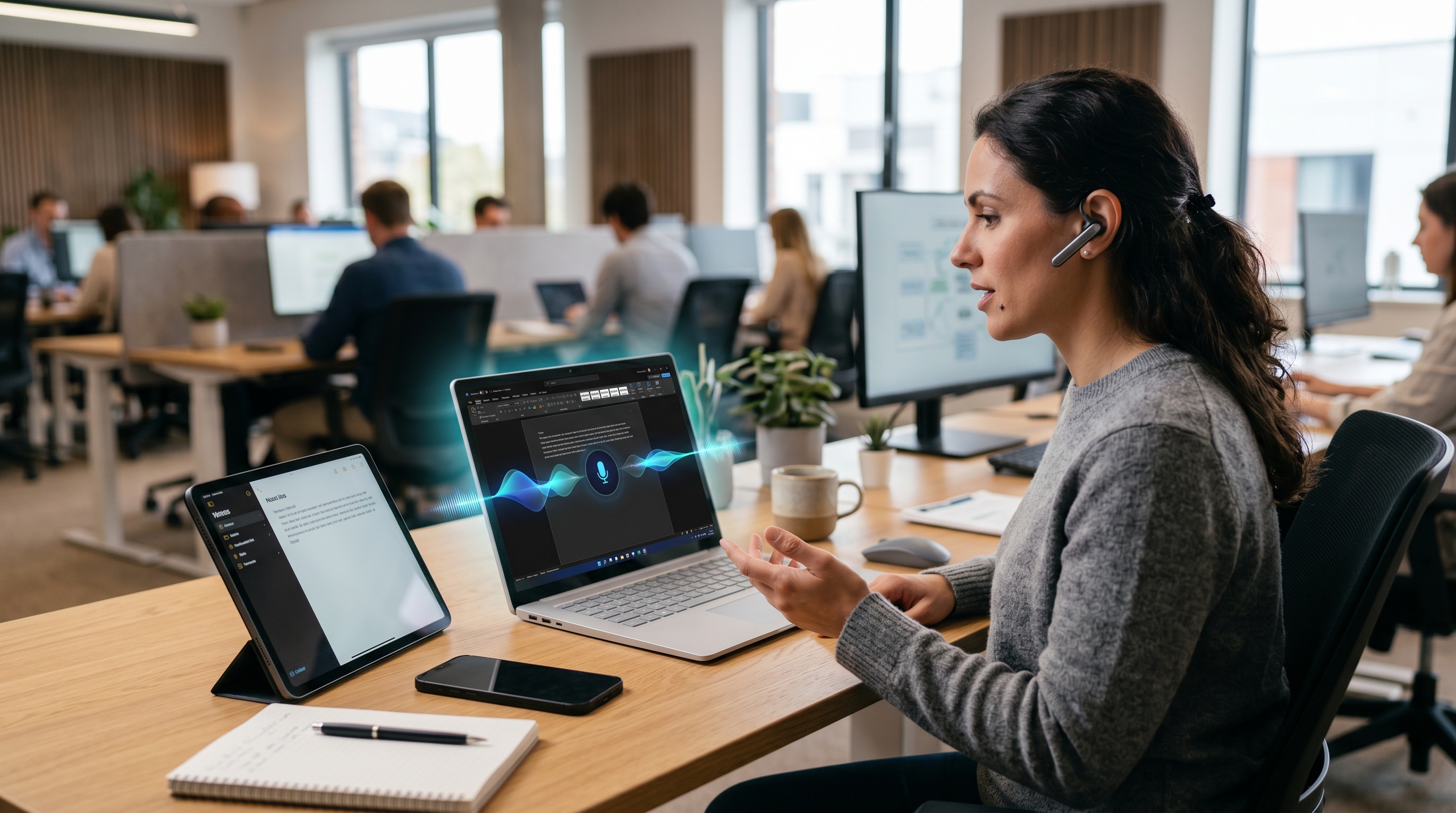
A new Gallup workplace survey released in April 2026 found that roughly half of all U.S. workers now use artificial intelligence in their jobs. The numbers are not subtle: AI has crossed the threshold from experimental curiosity to everyday work tool.
But here is what the headlines miss. While adoption is surging at the organizational level, the experience on the ground is uneven. Many workers report productivity gains but note that AI tools still force them to context-switch, reformat outputs, and manually move text between systems. The bottleneck has shifted from "can AI do this?" to "can AI do this inside the tools I already use?"
That is exactly the gap DictaFlow was built to close.
The Remote Desktop Problem Nobody Talks About
One of the biggest friction points in modern workplaces is the Citrix, RDP, and VDI layer. Millions of professionals work inside virtualized Windows environments where cloud AI tools break, lag, or simply refuse to install. When your entire workflow runs through a remote desktop connection, most AI assistants cannot reach you there.
DictaFlow is built to work inside those environments. Windows, Mac, and iOS native. No cloud dependency, no browser extension required. When you press the hold-to-talk button, your words go directly into whatever application is in front of you.
Mid-Sentence Correction Changes Everything
The other detail that separates useful AI dictation from frustrating AI dictation is the ability to correct mid-sentence. Most voice tools process your words in batches. You speak, wait, review, then fix. That pause breaks the flow and makes the tool feel slower than typing.
DictaFlow actually overrides mid-sentence. You can be halfway through a thought and redirect it entirely without stopping. That single feature turns voice dictation from a novelty into a primary writing mode.
The Productivity Angle Is Real
The Gallup data found that workers who use AI tools report higher productivity and lower frustration with repetitive tasks. But the survey also noted that adoption is uneven across industries and roles. Professionals who spend large portions of their day writing, documenting, or communicating are seeing the biggest gains. That describes doctors, lawyers, administrators, and knowledge workers across every sector.
Voice dictation is particularly powerful for these roles because it cuts out the keyboard entirely. A physician documenting a patient visit in Citrix can speak naturally while the system transcribes in real time. No switching windows, no copy-paste, no delays.
The Market Is Validating the Category
Google recently entered the voice dictation space, and Wispr Flow has gained significant traction on Mac. These are not threats to DictaFlow. They are validation. When major players invest in a category, it signals that the market has committed. The professionals who still cannot get reliable voice input inside their work environments will be looking for alternatives that actually work.
DictaFlow runs on Windows, Mac, and iOS. It bypasses the remote desktop layer that breaks cloud-only tools. It has hold-to-talk and mid-sentence override as core features, not premium add-ons.
The question for 2026 is no longer whether AI dictation belongs in professional workflows. The question is which tool actually works in the environments where professionals spend their day.
Try DictaFlow free at https://dictaflow.io/
Related DictaFlow Guides
Explore the pages built for the exact workflows these posts keep touching: Windows dictation, Citrix/VDI, medical documentation, legal drafting, and side-by-side comparisons.
Ready to stop typing?
DictaFlow is the only AI dictation tool built for speed, privacy, and technical workflows.
Download DictaFlow Free