The Hidden Cost of Always-On AI: Why Physician Burnout and EHR Fatigue Persist in 2026
February 17, 2026
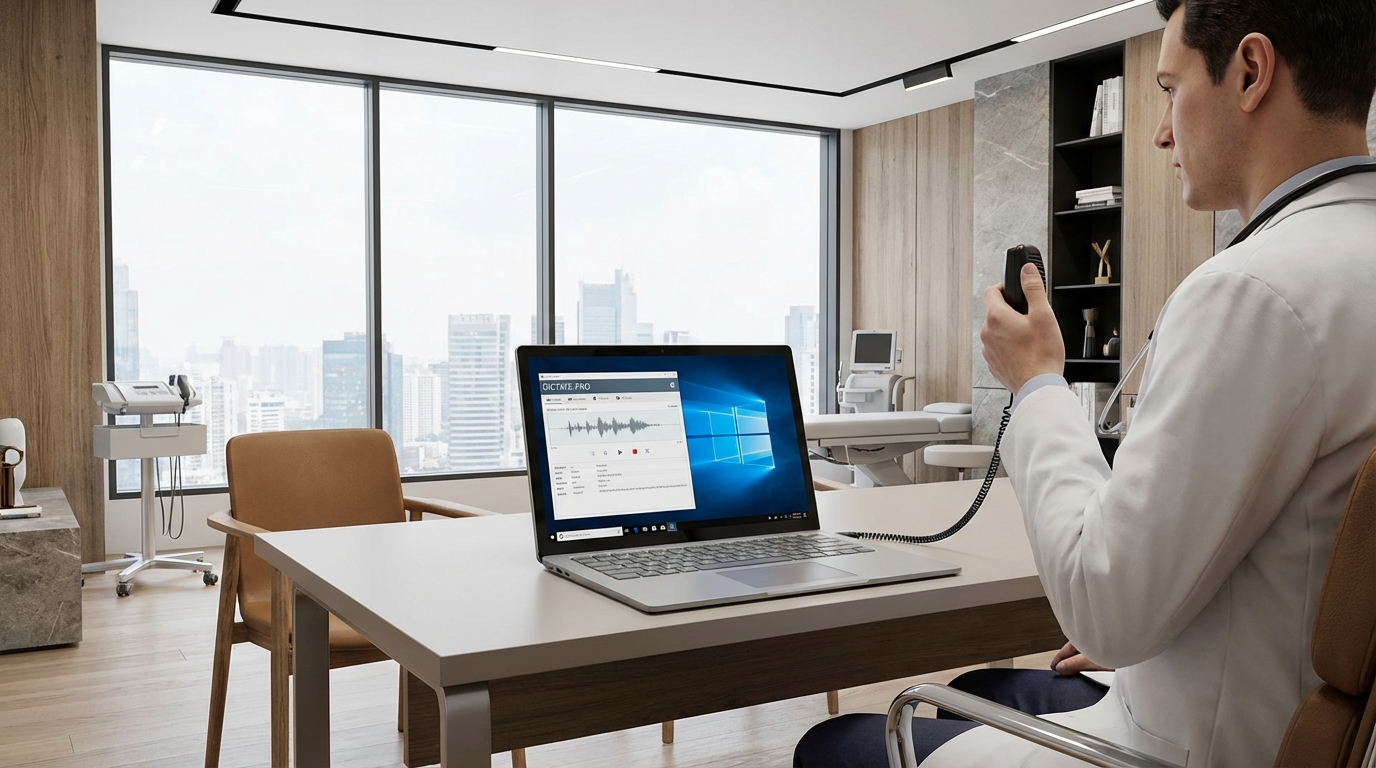
In early 2026, the medical community finds itself at a strange crossroads. On one hand, generative AI models have reached a level of accuracy once thought impossible, capable of parsing complex clinical jargon with near-human precision. On the other hand, physician burnout rates remain nearly double that of the general population. The promise of the "AI scribe" was supposed to liberate clinicians from the Electronic Health Record (EHR) bottleneck, yet for many, the administrative burden has simply shifted form rather than vanished.
The culprit? The "Always-On" dictation model.
While popular consumer AI tools have trained us to speak freely into an open microphone, the reality of a high-pressure clinical or legal environment is vastly different. When a tool is always listening, the user is always performing. This creates a new type of cognitive tax: the constant need to filter one's thoughts, the fear of "polluting" the transcript with side conversations, and the exhausting task of post-hoc editing.
The Attention Tax of Ambient AI
Modern AI medical scribes are often pitched as "ambient"—meaning they sit in the background and record the entire patient encounter. While this sounds convenient, it introduces a significant correction loop. A doctor spends fifteen minutes with a patient, and the AI produces a three-page summary. The doctor must then spend five to ten minutes meticulously reviewing that summary for clinical accuracy, hallucinations, or misinterpreted context.
This is where the efficiency gain evaporates. If the doctor has to spend a significant fraction of the saved time "babysitting" the AI output, the friction of the EHR remains. For many, this "review fatigue" is just as draining as manual typing.
The Case for High-Precision Control: Hold-to-Talk
This is why we built DictaFlow with a different philosophy: Hold-to-Talk (PTT). In professional environments—especially those involving VDI (Virtual Desktop Infrastructure) like Citrix or RDP—precision is more valuable than "ambience."
By using a physical or software-mapped hotkey to engage the microphone, the clinician regains intentionality. You speak only when you are ready to document. You release the key when you are finished. This eliminates the "background noise" of the room and, more importantly, the background noise of the conversation.
The result is a transcript that is already 95% of the way to a finished note, requiring seconds of review rather than minutes. It respects the clinician's flow rather than demanding they adapt to the AI's listening window.
Bridging the VDI Gap
For legal and medical professionals working in remote environments, the technical hurdle is even higher. Standard dictation tools often struggle with the latency inherent in Citrix or RDP sessions. They "lag" behind the cursor, leading to dropped words and formatting nightmares.
DictaFlow was engineered as a Windows-native application specifically to bypass these VDI bottlenecks. By processing the audio locally and "injecting" the text at the driver level, it ensures that your words appear in the EHR exactly where you intended them, in real-time, without the "ghosting" common in web-based alternatives. See the full breakdown of features designed for clinical workflows on the medical dictation for Windows page.
Reclaiming the Professional Workflow
As we move deeper into 2026, the novelty of "AI that can talk" is wearing off. Professionals are looking for "AI that can work." The difference lies in the interface.
The goal of medical and legal documentation shouldn't be to record everything; it should be to document the *right* things as efficiently as possible. By moving away from "always-listening" ambient models toward high-precision, hold-to-talk workflows, we can finally start to see the promised reduction in physician burnout.
Documentation should be a tool for the professional, not a separate job to manage.
Related DictaFlow Guides
Explore the pages built for the exact workflows these posts keep touching: Windows dictation, Citrix/VDI, medical documentation, legal drafting, and side-by-side comparisons.
Ready to stop typing?
DictaFlow is the only AI dictation tool built for speed, privacy, and technical workflows.
Download DictaFlow Free