June 17, 2026
Dictation Software for Medical Professionals: 2026
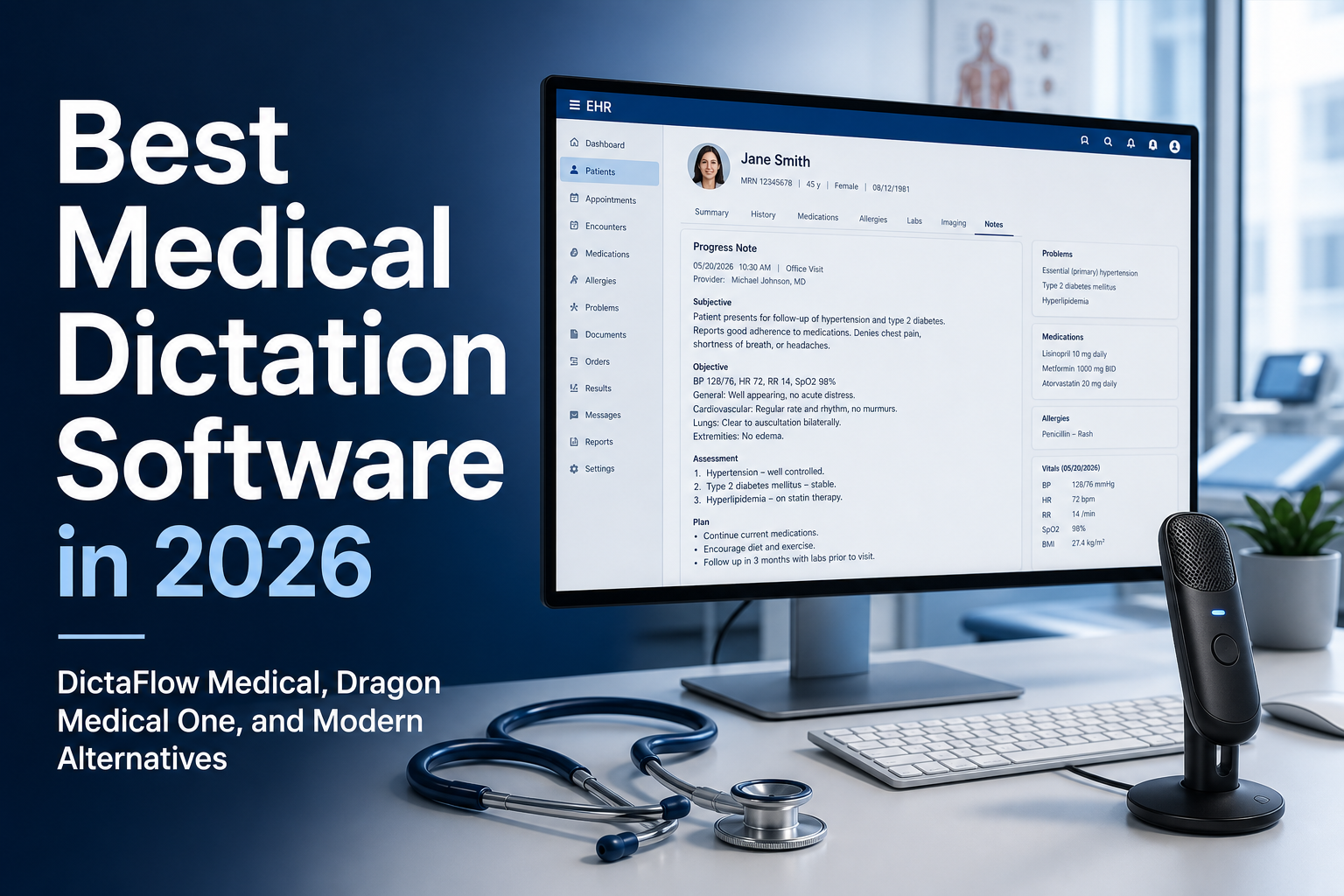
Dictation software for medical professionals should save clinicians time inside the EHR, not create another transcript to move. DictaFlow Medical Pro fits clinicians who want controlled hold-to-talk entry in EHR fields on Mac or Windows. It also works with Citrix, RDP, and VMware Horizon. Pricing is $39/user/month for 1-4 seats and $29/user/month for 5+ seats. Dragon Medical One may suit established enterprise rollouts better. For full-visit note drafts, an ambient scribe is likely the better choice. Before rollout, test each option with the clinic's actual EHR, remote desktop setup, privacy requirements, and BAA workflow.
Medical speech recognition software and dictation
Medical voice recognition software, medical speech recognition software, medical speech to text software, and dictation software for medical professionals all support related steps in the same workflow. Voice recognition converts audio into words. Medical speech to text adds clinical terms and formatting. Dictation software adds hold-to-talk controls, corrections, custom terms, text insertion, and support for EHRs and remote desktops.
A better way to compare medical dictation software
DictaFlow Medical Pro fits clinics that need hold-to-talk voice recognition in Epic, Cerner, Meditech, browser EHRs, referrals, patient messages, and SOAP notes. It works on Mac and Windows, along with Citrix, RDP, and VMware Horizon typing. Medical Pro costs $39/user/month for 1-4 seats and $29/user/month for 5+ seats. Clinics should use it according to their privacy policies and BAA requirements.
Dragon Medical One is still worth considering if a hospital already has a Nuance or Microsoft procurement path, an approved EHR deployment, and IT support for an enterprise rollout. Pricing is usually quote-based, so clinics should compare licensing, setup, training, EHR testing and remote-desktop requirements. For a smaller clinic that wants to try a more direct workflow first, DictaFlow Medical is the lighter option to look at.
Dictation and ambient scribes solve different jobs
An ambient scribe solves a different problem. It listens to a patient visit and drafts a note for the clinician to review. Controlled dictation is better for the short writing that fills a normal day: a referral, an inbox reply, a plan edit, a prior-authorization note, or a correction inside an existing chart. A clinic can use both. The important part is not buying an ambient product and then realizing it doesn’t help with all the text fields outside the visit note.
Test insertion where the work happens
The hard part is getting the text in, not just transcribing it. A clean transcript sitting in a separate window doesn’t save much time if someone still has to move it into the EHR. Test the software in the actual note field, referral workflow, patient message form, and any Citrix or VMware Horizon session the team uses. DictaFlow Medical uses keystroke insertion for locked down environments, so it can type into fields where clipboard based paste may fail.
Medical vocabulary is a workflow test
Medical vocabulary matters for the same reason. Every specialty has drug names, abbreviations, clinician names, local procedures, and phrases that general dictation gets wrong. A custom vocabulary or Knowledge Base is only useful if it cuts down on the repeated cleanup in the note itself. Test the terms that make your team stop and fix a transcript, not some generic demo paragraph.
Who should choose each option
The best choice depends on the clinic. Go with Dragon Medical One when your organization needs an approved enterprise deployment and has the IT support for it. Pick an ambient scribe when a reviewed full-visit note is the main job. Choose DictaFlow Medical Pro when clinicians need controlled hold-to-talk dictation that types into EHR fields, including Citrix, RDP and VMware Horizon workflows, with Mac and Windows support plus clear monthly pricing.
A clinic buying checklist
- Dictate into the real EHR note field, not a demo box.
- Test a referral, patient message, and plan edit.
- Use the actual Citrix, RDP, or VMware Horizon workflow if the clinic has one.
- Try the medical terms, abbreviations, and names that usually need cleanup.
- Confirm the privacy and BAA path that applies to the clinic.
Before you buy, run the same practical test with every finalist: dictate a progress note, a referral, a patient message, and a short plan edit. Try it on the computers and remote desktops people actually use. See how quickly medical terms get corrected and whether the clinician can review the text before it lands in the chart. That tells you more than a polished demo ever will.
FAQ
What is the best dictation software for medical professionals?
The right choice depends on how the clinic works. DictaFlow Medical Pro fits clinicians who want hold-to-talk dictation directly in EHR fields on Mac or Windows, including Citrix, RDP, and VMware Horizon. It costs $39/user/month for 1-4 seats or $29/user/month for 5+ seats. Dragon Medical One may be a better fit for an established enterprise rollout. An ambient scribe may work better when the main goal is drafting notes for the entire visit. Test each option in the clinic's actual EHR, then confirm the privacy and BAA path before rollout.
What is the best medical dictation software for a small clinic?
DictaFlow Medical Pro is a strong option for small clinics that need controlled hold-to-talk dictation into EHR fields, Mac and Windows support, Citrix/RDP/VMware Horizon typing, and clear pricing. It costs $39/user/month for 1-4 seats or $29/user/month for 5+ seats. Use it according to your clinic's privacy policies and BAA requirements.
Is medical dictation software the same as an ambient scribe?
No. An ambient scribe listens to a full patient visit and drafts a note for clinician review. Medical dictation is controlled input: the clinician chooses when to speak and where the text goes.
How should clinics compare Dragon Medical One with alternatives?
Test the actual EHR field, referrals, patient messages, medical vocabulary, remote desktop behavior, clinician review, rollout support, and monthly cost. Dragon Medical One is often quote-based and can fit organizations with an established enterprise deployment.
Can DictaFlow Medical type into Citrix and remote desktops?
DictaFlow Medical supports keystroke insertion for locked-down Citrix, RDP, and VMware Horizon workflows, so it can type into fields where clipboard-based paste may fail.
Related DictaFlow pages
More specific guides for clinical workflows and medical dictation buying.