Why I Built a Dictation App for People Who Chart at 9pm
I have never written a clinical note. Here is why doctors pulled me into this anyway.
November 06, 2026
I have never written a clinical note. That is the first thing you should know about me, and it's the thing I keep having to say out loud when doctors ask what my background is. Usually there's a pause on the line after I say it.
I'm Ryan, a solo founder in Toronto. I started out building dictation software for ordinary typing: emails, documents, messages to my own team. Doctors found it anyway. A few of them wrote to say they had tried it on their charting and that it had saved them something. I didn't believe it at first. I assumed medicine was a different universe, with its own vocabulary and its own rules.
It is. What pulled me in was a phrase I kept running into, in their emails and in the research: pajama time.
What pajama time is, and why the number got to me
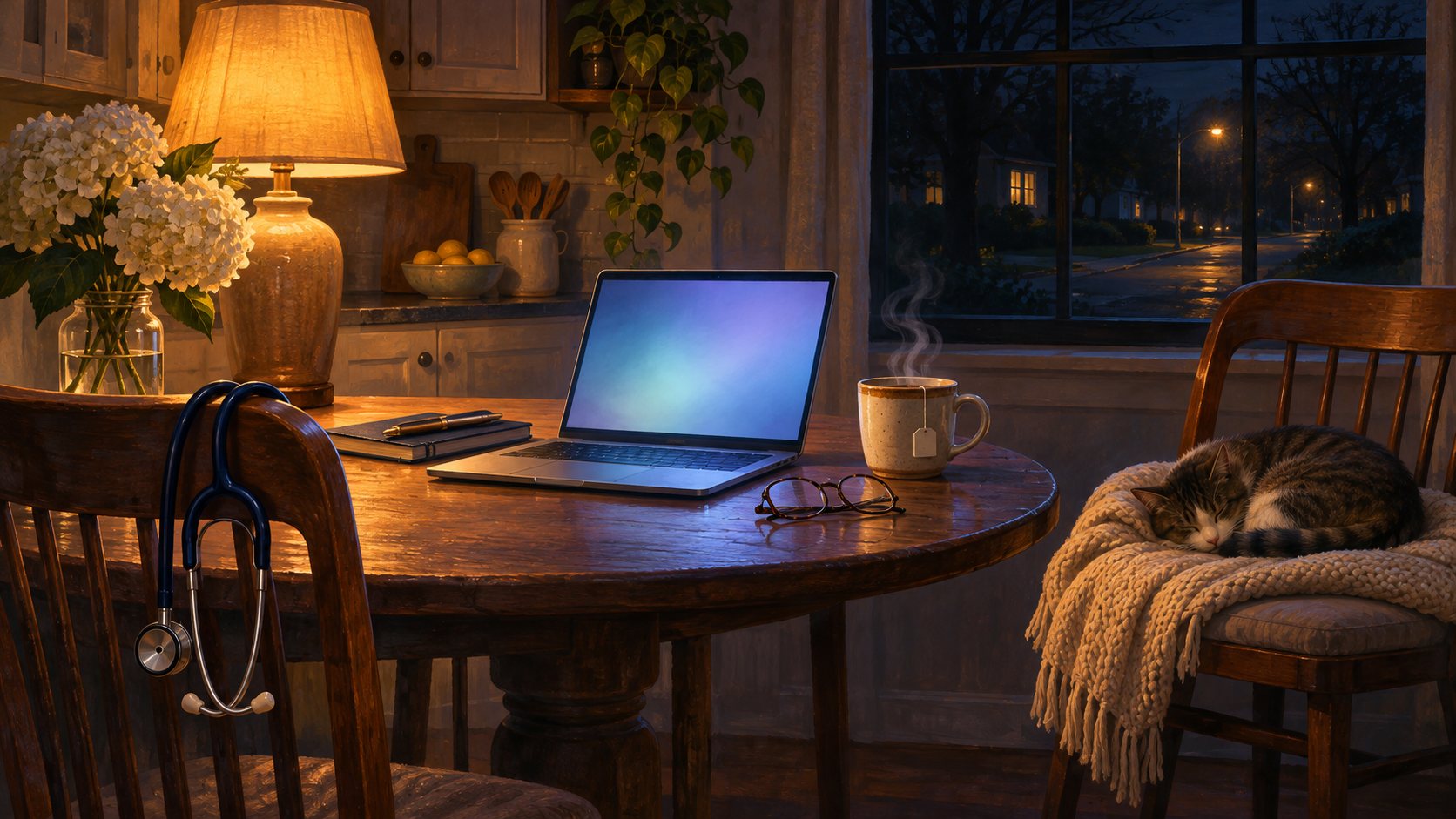
Pajama time is the charting you do at home, after the clinic closes. At the kitchen table, on the couch, in bed with a laptop on your knees while someone in the next room asks if you're coming to dinner.
In March 2026, Yale School of Medicine and the American Board of Family Medicine published work on this in Academic Medicine. They surveyed family medicine residents after the 2024 in-training exam. Of the 3,931 residents above their first year who answered the EHR questions, some reported three or more hours a night of after-hours EHR work, and that group was tied to higher burnout and lower professional satisfaction.
Three hours a night. After a full day of patients, when you'd normally be eating something standing up and asking how the kids' day went, and I keep coming back to how ordinary that picture is.
I read that and thought about my own work habits. When I'm behind, I stay up. But I'm behind on my own company, and I chose it. Residents are behind on other people's lives, and the charting is the part of the job that can't be handed to someone else.
The first thing I got wrong
My first instinct was the engineer's instinct: make it faster. If the problem is typing, build a faster way to type. In a Stanford study from 2016, researchers found that speech recognition on a phone was about three times faster than typing in English. I leaned on that number for months.
It's a real result, and it's also a bit of a trap. The study was about short text messages on an iPhone. A clinical note is a different animal. It lives inside a particular field in a particular EHR, often through a remote desktop, and it has to be right in places where a wrong word is more than embarrassing. Speed alone fixed nothing. If your dictation tool puts the words in the wrong box, or can't reach the box at all, three times faster is worth nothing.
So the real work turned out to be reaching the field.
The part of the day the app can't touch
Here's the uncomfortable thing I've come to understand. A dictation tool shrinks the time it takes to put words into a note. It does not shrink the number of notes, the inbox, the prior authorizations or the checkbox you have to click so the billing system is happy.
I don't want to sell you a story where one app gives you your evenings back. Some of what keeps people at the kitchen table is structural, and it won't change because of anything I build. A doctor who wrote to me said that even with a good tool there were still too many clicks to move text from one place to the next. They were right, and it's on my list.
What dictation can do, and this is the whole claim, is take the narrative part of the work, the assessment and plan, the referral letter, the patient message, and let you speak it in the moment instead of reconstructing it at 9pm from memory. That's a smaller claim than "reclaim your life." It's also one I can defend.
Why I built hold-to-talk instead of always-on
Many newer tools listen through the whole visit and write the note for you. They exist, they can be good, and I built one myself. But I started with something simpler, because of how doctors described their days.
You press a key. You talk. You let go. Nothing records unless you hold the key down.
It sounds almost too basic. But I like it for that reason: you stay in control of what becomes part of the record. You say the paragraph you want, you read it where it lands, you fix the one word it got wrong, and you move on. There's no pile of generated text waiting for you at the end of the day.
I think control matters more here than it does in most software. A note in a chart is a legal document with your name on it. I'd rather build something that helps you write what you meant than something that writes what it guessed.
What I tell people to try first
If you're curious about dictation but you're tired and skeptical, which is a fair description of most people who write to me, here is what I'd do. It takes about twenty minutes.
- Choose one repetitive thing you write several times a week. A follow-up note, a letter, a reply to a patient message.
- Use fake text, not a real patient, while you test. Make up a case if you have to.
- Dictate it into the exact field you'd normally type in.
- Notice where it lands and where it doesn't.
That last step surprises people, because they expect the first test to be about accuracy. Check where the words arrive first. If you work in Epic through Citrix or a remote desktop, that is the make-or-break question, and I'll go through it in detail in another post.
The honest small print
I keep a rule when I write these: if a sentence sounds like an ad, it gets cut or rewritten until it sounds like something I'd say across a table. Forgive me if one slipped through.
DictaFlow Medical is $39 a month per user for one to four seats, $29 a month per user at five or more, and there's a free tier with 2,000 words a month so you can find out before you pay. It runs on Windows, Mac, iPhone, iPad and Android.
I'm not going to tell you what it will save you. I don't have a number I trust, and the numbers vendors usually quote come from their own best customers. What I can say is that nobody has to take it on faith. Try it for a week on the notes you hate most.
One thing before any patient information goes near it: your organization should do its own vendor review and sign a business associate agreement if one is needed. I can walk a clinic through the documents. But please ask for them, and read them.
What this actually changed for me
I used to think of this as a speed problem. I now think of it as a problem of who gets to be home.
The residents in that study were not asking for faster typing. They were asking, in survey form, for fewer evenings spent at a screen. A dictation app is a small part of the answer. It's the part I know how to build, so I'm building it, and I'm trying to be careful not to promise more than that.
If this is your evening, and you want to see whether speaking your notes helps, you can start free here: dictaflow.io/medical. Tell me where it fails. I'm the one who reads the replies.
The most useful replies I get are never compliments. They're lists of everything that annoyed someone.
Try DictaFlow Medical free
2,000 free words a month. Test it on fake text in your own EHR before you decide.
See DictaFlow Medical