Google Just Entered the Dictation Race - Why DictaFlow Still Wins in 2026
50|April 13, 2026
51|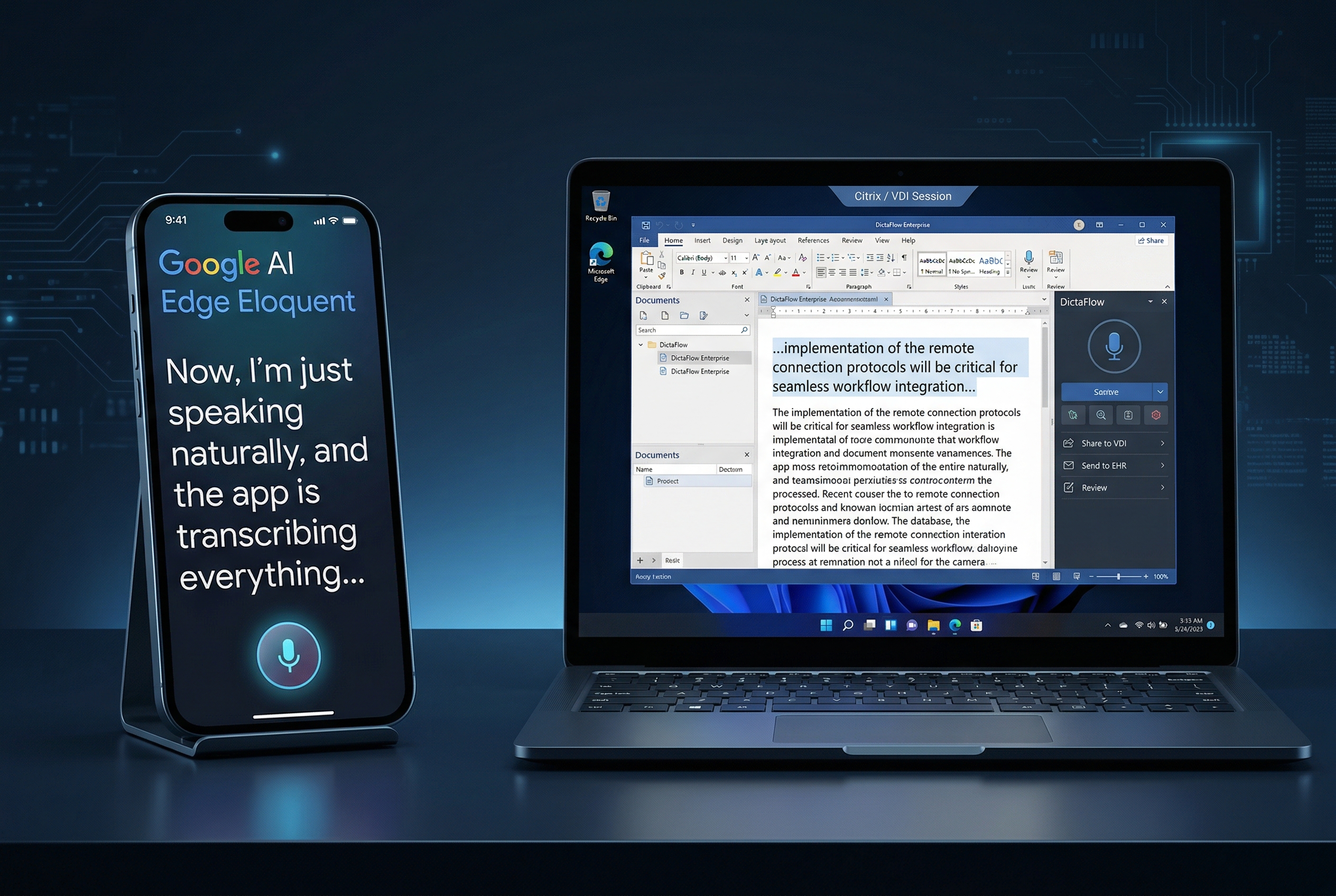 55|
55| Google quietly dropped a new app into the iOS App Store this week with almost no announcement. It is called Google AI Edge Eloquent, it is free, it works offline, and it does real-time voice-to-text with Gemini-powered cleanup on-device.
60| 61|On the surface this looks like bad news for every dictation app on the market. Google entering the space with free, cap-free, offline voice input is a serious statement.
62| 63|But here is the catch that nobody in the tech press is writing about yet: Google is targeting consumers with this launch. There is a massive segment of knowledge workers who cannot use this app at all.
64| 65|The Gap Google Cannot Fill
66| 67|If you work inside a hospital network running thin-client Citrix, or a law firm logged into a terminal server via RDP, your iPhone mic is useless. The dictation has to reach the machine you are looking at. The app on your phone cannot type into the EMR, the case management software, or the document portal running on a remote Windows host.
68| 69|This is the exact problem DictaFlow was built to solve. DictaFlow runs on Windows and Mac natively. It simulates keyboard input at the driver level, which means it can dictate directly into any application inside a VDI session without the input lag or complete failure that plagues browser-based and cloud dictation tools.
70| 71|What Google Gets Right
72| 73|Eloquent does some things well. The offline Gemma-based model is genuinely private, the filler-word stripping is smart, and the lack of per-character caps is refreshing. Google is clearly signaling that voice input is becoming a first-class interface, not a novelty feature.
74| 75|That validation matters. When Google builds voice into Android and iOS at the OS level, more people expect to dictate. Professional workflows adapt. And that creates more demand for tools that actually work in enterprise environments where the real productivity gains are.
76| 77|Hold-to-Talk Changes the Game
78| 79|One underappreciated detail in modern dictation is how the capture mechanism works. Cloud tools listen continuously, which means they are constantly processing ambient noise, cross-talk, and half-finished thoughts. For clinical and legal environments where accuracy matters, that is not a small problem.
80| 81|DictaFlow's Hold-to-Talk mode lets you capture exactly what you mean before you say it. Press, speak, release. The transcript arrives clean because the context was clean.
82| 83|Actually Override
84| 85|Another underappreciated feature: mid-sentence correction. Anyone who has used voice typing for more than five minutes knows the moment where you said the wrong word, backtracked, and the transcript just appended instead of replaced. DictaFlow handles this differently, using few-shot prompt engineering to interpret correction patterns as they happen, not after.
86| 87|The Bottom Line
88| 89|Google entering the dictation space is not a threat to DictaFlow. It is market validation. More professionals will expect voice input to work everywhere. The ones trapped inside Citrix, RDP, and VDI environments will still need a tool that speaks their language.
90| 91|DictaFlow is built for Windows, Mac, and iOS. It bypasses the remote desktop layer that breaks every cloud-only tool. Try it free at dictaflow.io.
92| 93|Related DictaFlow pages
If this topic interests you, these pages have more detail.