August 17, 2026
Police Report Dictation Software in 2026: Field Guide
Choose between officer-authored dictation, body-camera drafting, and integrated RMS tools without skipping review or agency security checks.
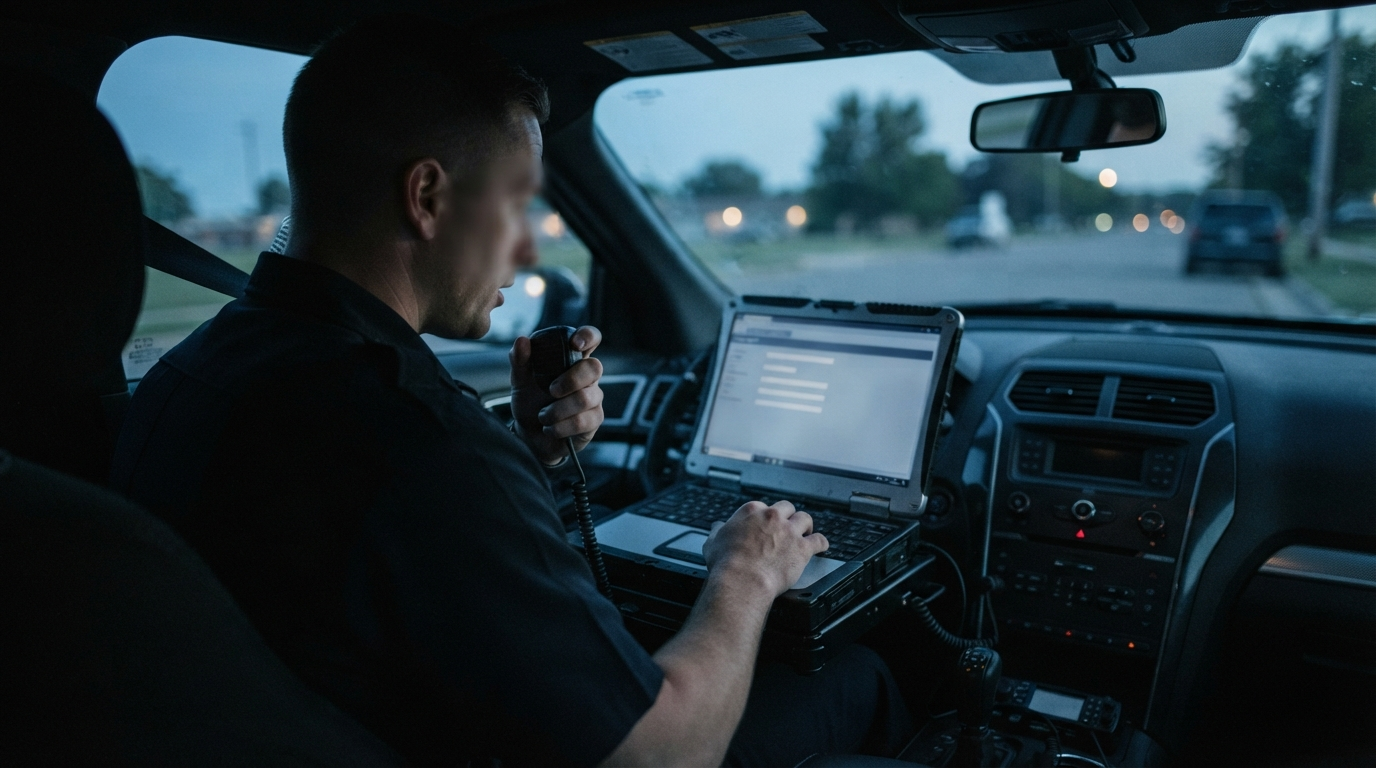
Police report dictation software covers two very different jobs. One turns an officer's own words into editable text. The other processes body-camera audio, drafts a narrative, fills records fields, and moves evidence through an agency system.
That difference matters even more in 2026. Police departments now have dedicated products such as Axon Draft One, Code Four, and CentralSquare Centerline AI. Officers still need a quick way to dictate short narratives, supplemental notes, emails, and administrative updates into the field already open on screen.
The right setup depends on the report, the records system, and the agency's security rules. A general dictation app doesn't bypass CJIS review. It may still work for approved tasks that don't involve CJI, or in a deployment the agency has tested and authorized.
Start with the report, not the microphone
Before comparing products, map the actual writing path. Where does the narrative begin? Does the officer write directly in the records management system, dictate into a separate editor, or start with body-camera audio? Which fields accept normal keyboard input? Does a supervisor review the draft before submission?
A tool can look fast in a clean demo but still fail at the last step. Some records systems run in a browser. Others run through Citrix, VMware Horizon, or Remote Desktop. Clipboard paste may be blocked, and long text can end up in the wrong field if the focus shifts. A mobile app may create a strong draft but still leave the officer with one more transfer to complete.
Run the test in the real RMS and on the same managed device officers use. A transcript that works in Word proves very little.
Three types of police report dictation software
Traditional speech recognition lets the officer author every sentence by voice. Dragon Law Enforcement and similar tools are built around this model. The officer speaks the narrative, reviews the text, and submits it through the usual process. This is closest to typing, only faster when recognition and vocabulary are good.
Body-camera drafting tools use recorded encounter audio as their starting point. Axon says Draft One turns body-worn camera audio into a narrative. The officer must then review, edit, and sign off on it before the report moves into Axon Records or another RMS. This can reduce the need to retell the same events, but it also raises harder questions: What did the camera miss? How was the draft produced? How is the officer's review documented?
Integrated RMS tools do more. CentralSquare says Centerline AI accepts voice dictation, builds narratives, and connects report writing with its CAD and records products. Code Four advertises body-camera report drafting, RMS integrations, and CJIS controls. Agencies procure these products, rather than downloading them for personal productivity.
Security approval is a pass or fail requirement
Police report dictation software may handle criminal justice information. The FBI CJIS Security Policy covers the creation, viewing, modification, transmission, storage, and destruction of CJI. That means the question is not merely whether a vendor says its traffic is encrypted.
An agency should check where audio and text are processed, who or what services can access them, how accounts are authenticated, where logs are stored, how long data is kept, and whether the vendor's commitments match the state CJIS agreement and agency policy. Cloud hosting from a familiar provider does not automatically approve the application built on top of it.
Consumer voice tools often fall short here. If a vendor can't meet the agency's requirements for review, contracts, access controls, and audit trails, don't send CJI through it. Use harmless sample narratives for testing. Never use a real victim's name, address, plate number, case number, or body camera recording.
Human review cannot be a rubber stamp
A clean draft can still be wrong. Body-camera audio may miss events outside the microphone's range. Names and street addresses can be misheard. A generated narrative may sound more certain than the source supports.
The officer should check the draft against their notes, recordings, and memory. Names, times, statutes, plate numbers, serial numbers, quoted statements, and the order of events need separate checks. When agency policy requires it, supervisors should also know which parts came from dictation, transcription, or generated text.
Late-July reporting from StateScoop described Code Four using "Easter egg" details to check whether officers actively review a draft. The broader test is simple: can an officer spot planted errors in a sample report before submitting it? If the workflow encourages officers to skim polished paragraphs, the time saved could create a new accuracy problem.
Where system-wide dictation fits
Not every voice task needs a body-camera report generator. Officers and civilian staff also write training notes, scheduling updates, internal emails, equipment requests, public-facing summaries, and other text that may sit outside CJI workflows. For approved tasks, system-wide dictation can be the lighter option.
DictaFlow uses a hold-to-talk setup. Hold a hotkey, speak, then release it to place the text in the active field. On Windows, Typing Mode enters text with keystrokes, so it works in Citrix, VMware Horizon, and Remote Desktop fields where clipboard paste is blocked. The Knowledge Base remembers recurring names and agency terms. App-aware formatting also adjusts the cleanup for the app you're using.
DictaFlow isn't presented as a CJIS-approved police reporting platform. Agencies shouldn't use it for CJI unless their security and legal teams approve the exact deployment and data path. It's best suited for approved general dictation, testing with synthetic text, or non-CJI administrative work where system-wide insertion matters.
DictaFlow Pro costs $7/month or $69/year. The dictation software comparison shows how it differs from built-in tools and dedicated apps. The getting started guide explains how to set up hotkeys and test text insertion.
A practical agency pilot
Use a small pilot before buying licenses across a department. Build five synthetic report scenarios that include street names, radio codes, dates, quoted speech, and a long narrative. Add one Citrix or remote RMS session if that matches production.
Measure correction time, not just transcription speed. Check for wrong names, missing negations, incorrect numbers, misplaced text, and unsupported details. Track how long it takes to review the final narrative. A draft produced in thirty seconds isn't fast if verifying it takes longer than writing it from scratch.
Test failure cases too. Disconnect the network, switch microphones, pause mid-sentence, move between the narrative and form fields, and let the session time out. Check what happens to unsent audio and partial text. Then ask security staff to verify retention, access, logging, and deletion against the vendor's contract.
The final choice may be two tools instead of one: an agency platform for CJI and body-camera work, plus a simpler dictation tool for approved administrative text across the system. Make those boundaries clear in training and policy.
What to choose in 2026
Choose traditional officer-authored dictation when the main problem is typing a narrative into an existing RMS. Choose body-camera drafting when the department wants to reuse encounter audio and can support the review, governance, and integration work. Choose an integrated RMS product when voice input is part of a larger records modernization project.
For simpler, approved writing in desktop apps and remote sessions, test a system-wide dictation tool with synthetic text. Convenience does not mean you have authorization.
The best police report dictation software isn't the one that creates the longest demo report. It's the one that puts accurate text into the actual system, lets officers review it, and meets the agency's security rules.