July 24, 2026
Can Parakeet, Whisper, and Qwen Replace Wispr Flow?
Speech recognition is only half the pipeline. Small local language models are starting to handle the cleanup too.
By Ryan Shrott, founder and developer of DictaFlow
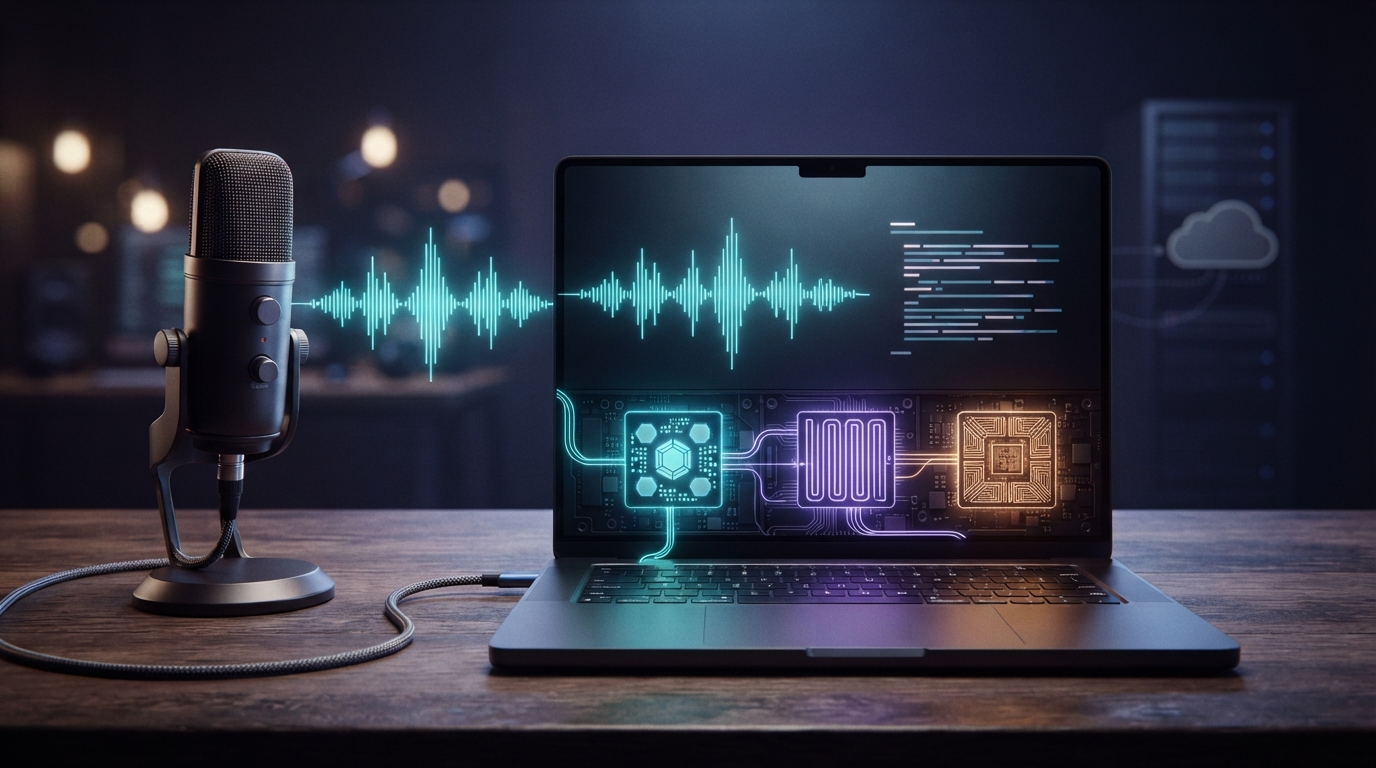
Tap the dictation button and two jobs begin. First, a speech model turns your voice into rough text.
A language model may then clean up the text. It can remove filler, fix punctuation, or format an email. Wispr Flow runs both jobs on remote servers, but local models can now split the work.
Parakeet or Whisper can handle the speech. A small Qwen model can clean the text on devices that are fast enough. The app still needs to record well and put the result in the right place.
Local models can replace Wispr Flow for basic dictation today. Polished rewrites are harder. They depend on the device, the prompt, and how long the user is willing to wait.
One button can run two models
It helps to treat listening and editing as two jobs. The speech model needs to catch words quickly. The cleanup model gets text and follows a short list of rules.
Parakeet is small and fast enough for common devices. Whisper needs more power, but it covers more languages and gives you more control over words.
A cleanup prompt should stay narrow. It can remove filler, add punctuation, keep names, or format an email. It should not research a topic or write a new essay. Dictation cleanup should stay small.
Qwen3.5 is available through local tools such as Ollama in 0.8B, 2B, 4B, and 9B sizes. A small compressed model may not rewrite as well as a large cloud model. That is fine if it stays fast and keeps the speaker's meaning.
The editor should fix the transcript, not show off.
A local dictation pipeline
Each stage has a narrower job. That makes local performance and error handling easier to control.
Parakeet is built for speed
Parakeet became the default while I built DictaFlow's Local Offline Mode because it stayed out of the way. On Apple devices, Core ML and the Neural Engine do the work.
Windows uses a native ONNX path that runs on a normal x64 laptop. Loading the model before the first recording matters almost as much as choosing the model. Fast speech processing means little if the app waits several seconds before it starts.
Custom words can make the fast path harder. Push word boosting too far and the model may slow down. It may also change a normal word into a protected term. Some jobs need a slower mode with tighter control over key terms.
Whisper gives you more control
Whisper is slower, but it gives you more control. It comes in several sizes and covers many languages. Tools such as WhisperKit and whisper.cpp help it run on different devices.
A smaller Whisper model can make sense on Apple hardware when names, accents, or language choice matter. Our first whisper.cpp test on an average Windows laptop took about six or seven seconds for a short clip. The text was right, but the wait broke the flow.
It was local speech recognition, but it did not feel like dictation. The model, software, and device need to fit each other.
If the result breaks your train of thought, a good benchmark score does not help.
| Model | Job | Strength | Trade-off |
|---|---|---|---|
| Parakeet | Speech to text | Fast everyday dictation | Less steerable vocabulary |
| Whisper | Speech to text | Languages and prompting | Higher latency |
| Small Qwen | Text cleanup | Private narrow rewrites | Memory and device variance |
| Cloud LLM | Text cleanup | Complex transformations | Network and remote processing |
These models solve different parts of the pipeline. Comparing them as one accuracy leaderboard misses the point.
Qwen can clean up the text
Raw speech looks like real speech. It has repeated words, false starts, filler, and long lists with no breaks. Some of that carries meaning. Some is just noise.
A small local language model can handle a short list of edits:
- add punctuation and paragraph breaks
- remove obvious filler without deleting meaning
- format a rough sentence as an email
- preserve protected names and product terms
- apply a narrow style prompt for the active application
The rules must be clear. A prompt such as "Improve this" gives the model too much freedom. Tell it to keep facts, numbers, names, doubt, and meaning. Then allow only the format changes you asked for.
Delay can ruin the setup even when both models work. Run speech and cleanup one after the other, and a quick note starts to feel slow. A 0.8B or 2B model is easier to run fast, but it can do less.
A 9B model may clean text better, but it can use several gigabytes of memory. Phones have less memory and get hot faster than laptops. The right local editor will change by device, just like the speech model.
What works today
Open-source projects already connect local Whisper to tools such as Ollama for text rewriting. The pieces work. But downloading two models and joining them together is not the same as a fast, reliable dictation app.
DictaFlow now ships the speech half of this setup. Local Offline Mode uses Parakeet or Whisper on supported Windows, Mac, and iPhone devices.
Dictionary changes and protected words stay on the device. AI Refine and email cleanup still use the cloud. DictaFlow does not yet ship Qwen for local cleanup.
That gap is on purpose. Local cleanup must keep the meaning and stay fast. It also cannot use too much memory or make the device too hot. A working demo is not enough to ship.
When the cloud still helps
Remote models have more memory and computing power. They also do not heat up your phone or laptop. That extra power helps with hard rewrites, long text, several languages, and jobs where a small local model drops details.
The cloud can also make support easier. The vendor controls the model and updates it in one place. The app can act the same across devices without another large download.
The cloud is useful for hard work. Normal dictation can use a simpler path:
- local speech recognition for ordinary dictation
- deterministic local substitutions for protected vocabulary
- small local language models for light cleanup where hardware allows
- cloud models for demanding transformations or when the user chooses them
If the connection drops, basic dictation can keep working instead of showing an error.
Can local models replace Wispr Flow?
For fast speech to text in email, notes, documents, prompts, and messages, Parakeet or Whisper can already do the main job locally. Turning every rough thought into polished writing is less reliable. A strong laptop can run a small Qwen model for light cleanup, but older devices and phones will vary.
Clear prompts and strict rules matter as much as model size. The cloud still helps when a rewrite needs more text or more power. Basic dictation should not need it every time.
I built DictaFlow. Its Local Offline Mode focuses on the first job: fast, private dictation that keeps working without a network. Pro users get unlimited local dictation. Cloud AI is still there when cleanup truly needs it.
If a dictation app needs the internet, ask which step needs the server. Often, it is only the cleanup step. Compare DictaFlow with Wispr Flow, Dragon, Superwhisper, and other dictation tools in the full 2026 comparison.