July 18, 2026
I Do Not Always Know Where My Dictation Should Go Yet
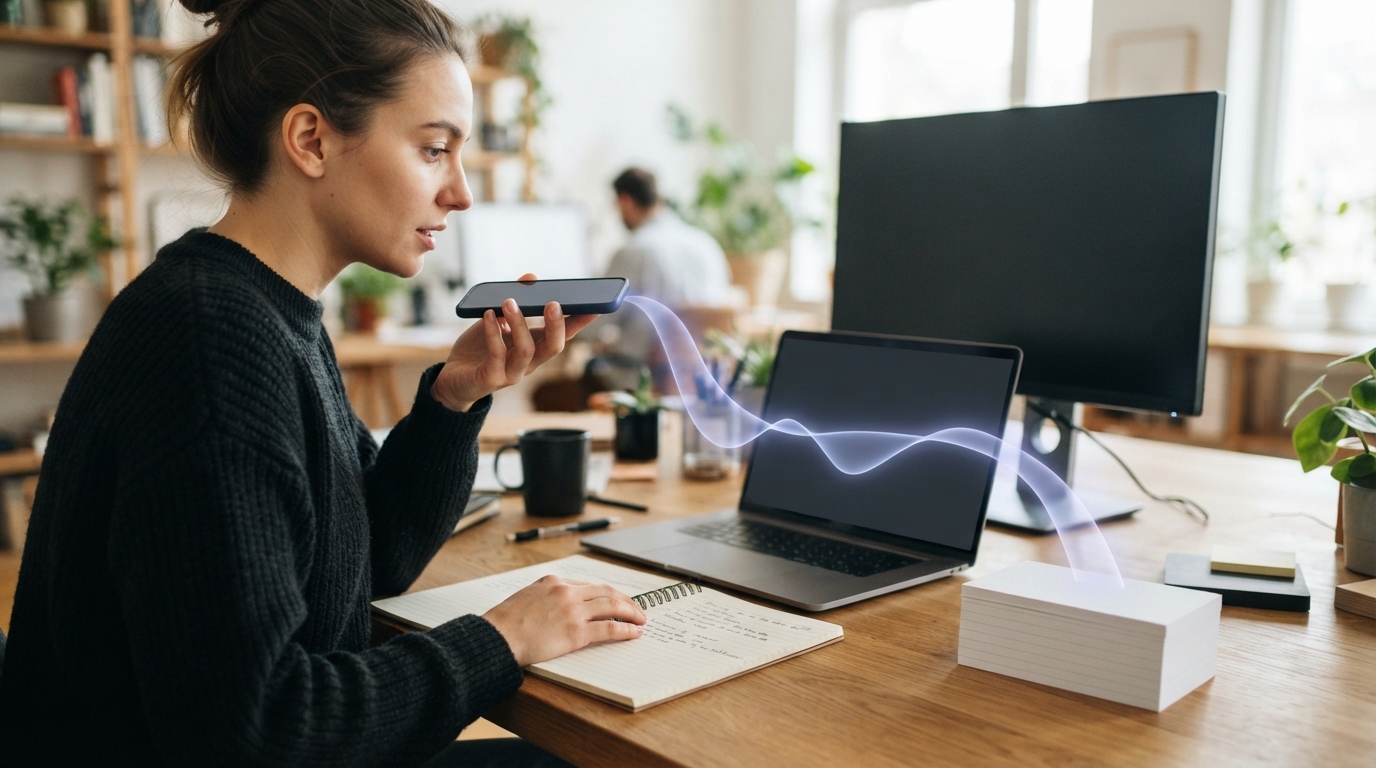
The cursor is sometimes the wrong destination
I like cursor-based dictation when I know what I am doing. A quick Slack reply, an email, a paragraph in a note. It feels direct. But when I am trying to think through a project, I often do not know where the words belong yet. I just know I need to get them out before they disappear.
One Reddit commenter described exactly that need. They wanted dictation to land in a background note during a multi-app flow, then be reviewed and edited later. They did not want to keep worrying about which field happened to have focus at the end of every spoken turn.
Two different voice workflows
Direct insertion is for action. Capture-first is for thinking. The first one belongs in the field in front of me. The second one belongs somewhere safe, searchable, and private until I decide what to do with it.
I have seen people describe this in voice-note workflows too. They talk through a long idea while driving or walking, then let the note become a plan later. The useful part is not an assistant pretending it knows where the thought belongs. It is preserving the thought until the person is ready to shape it.
What I would want from a capture mode
I would want it to start fast, keep timestamped chunks, stay searchable, and make the eventual handoff deliberate. I would not want it to guess which app should receive the next thought. That is the whole reason I put it in a background note in the first place.
The more I think about it, the more this feels like a separate product job, not a missing checkbox in ordinary dictation. Sometimes the right place for a sentence is the cursor. Sometimes the right place is nowhere yet.
The ideas that do not fit in one box
Some of my best thoughts arrive while I am doing something else. I am switching between a browser, a note, a chat, and a task list, and I know I need to capture a sentence before it disappears. The idea is real, but the destination is not decided yet. That is a very different feeling from dictating a reply into a focused field.
I think a lot of people have learned to work around that gap by sending themselves voice notes. The workaround is fine, but it also tells you something: they are not looking for prettier transcription. They are looking for a place to think out loud without being forced to file every thought immediately.
What I would want to keep private
A background capture workflow also makes me think about where the raw material lives. Long rambling notes can contain more personal detail than a polished email. If I am using them to work through a problem, I want to know whether I can keep that capture local, whether I can use a cloud model only when I want help organizing it, and whether I can delete it cleanly afterward.
That local-and-cloud choice is useful here too. Sometimes I want the speed of a local offline capture. Sometimes I want a cloud model to help turn the rough note into something structured. I do not want to be forced into one approach for every thought.